7 Best Ways to Encourage Reading in Reluctant Readers (That Actually Work)
My son threw a hardcover book at the wall last Tuesday. Not at me — just at the wall. He was seven, the book was “too boring,” and I was standing in the wreckage of my own grand plan to raise a reader. I had curated a shelf of beautiful, award-winning chapter books, and he hated every single one. That night, I did something that felt like giving up: I handed him a Dog Man comic and said nothing. He read it twice before bed. That was the moment I realized I’d been fighting the wrong battle — and it’s why I can tell you these best ways to encourage reading in reluctant readers aren’t about “fixing” your kid. They’re about changing the game entirely.
Start Where They Are – Let Them Read Anything (Yes, Anything)
When I stopped gatekeeping what counted as “real reading,” the resistance in our house dropped by about 80%. Not overnight, but close. The core idea here is simple: a reluctant reader isn’t a broken reader. They’re a kid who has learned that reading feels like a test, a chore, or a judgment. Removing that judgment is the first — and most counterintuitive — of the best ways to encourage reading in reluctant readers. You have to let go of the hierarchy. Graphic novels? Yes. Magazines about dirt bikes? Yes. The back of the cereal box? Still yes.
I remember a dad at our local library who was visibly pained that his eight-year-old only wanted the Lego Ninjago visual dictionary. “It’s not even a story,” he whispered. But the kid was reading the captions, decoding diagrams, and narrating battles to himself. That’s reading. That’s engagement. When you broaden the definition, you stop treating non-traditional reading materials as a compromise and start seeing them as a bridge. The research backs this up: the Scholastic Kids & Family Reading Report consistently finds that kids who are allowed to choose their own books — any books — read more often and feel more positive about reading. Choice is the engine; format is just the vehicle.
Why Graphic Novels and Comics Are a Gateway Drug to Reading
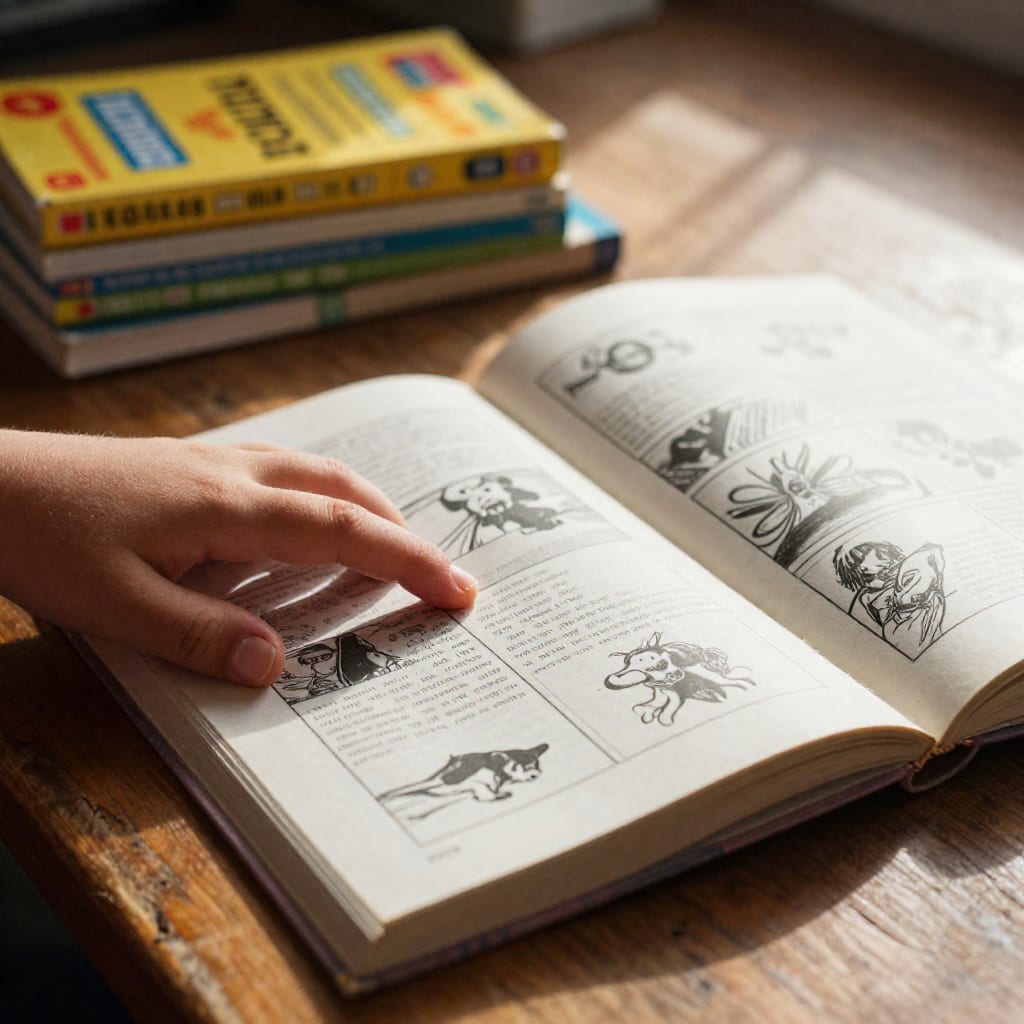
I’ve heard the phrase “gateway drug” used half-jokingly by teachers, and honestly, it fits. Graphic novels for reluctant readers work because they remove the visual intimidation of a wall of text. A child opens a page and sees white space, expressive faces, and action lines. Their brain doesn’t scream “workload.” Instead, it sees a puzzle: how do the words and pictures talk to each other? This is sophisticated cognitive work.
When my son was deep in his Dog Man phase, I noticed he was tracking dialogue bubbles across panels, inferring emotions from character expressions, and predicting plot twists — all skills that transfer directly to text-only books. Comics build reading skills by demanding inference and sequencing in a low-anxiety format. The vocabulary in many graphic novels is actually more complex than early chapter books, because the images carry the basic narrative while the text can stretch. A reluctant reader graphic novel habit isn’t a stall; it’s a runway.
Audiobooks Count – They Build Vocabulary and Narrative Skills
We were on a long drive to my sister’s house when I first put on an audiobook out of desperation. My son, who’d been complaining about the car, the sky, and the existence of socks, went completely silent. Afterward, he asked a detailed question about the main character’s motivation that proved he’d been listening harder than I had. That’s when I stopped feeling guilty about screen-free ear time.
Audiobooks for reluctant readers are not cheating. A child who listens to a story above their independent reading level is still absorbing sentence structure, new vocabulary, and narrative arc — the same cognitive building blocks they’d get from decoding print, minus the decoding fatigue. For a kid who struggles with fluency, that fatigue is the whole barrier. Benefits of audiobooks for kids include reduced anxiety and increased motivation, because the story is accessible now. I treat audiobooks as a parallel track: while my son’s eyes get stronger with comics, his ears are building a mental library of plots and language. They’re two lanes on the same road.
Make It a Shared Experience – Read Aloud Together Without Pressure
I used to read aloud with a hidden agenda. I’d pause and ask, “What do you think that word means?” or “Can you read this sentence for me?” My son would stiffen up instantly. I was turning a warm sofa moment into a pop quiz, and he knew it. The shift came when I started treating read-aloud time as purely connective. I read, he listened, and the only questions were the ones he asked me.
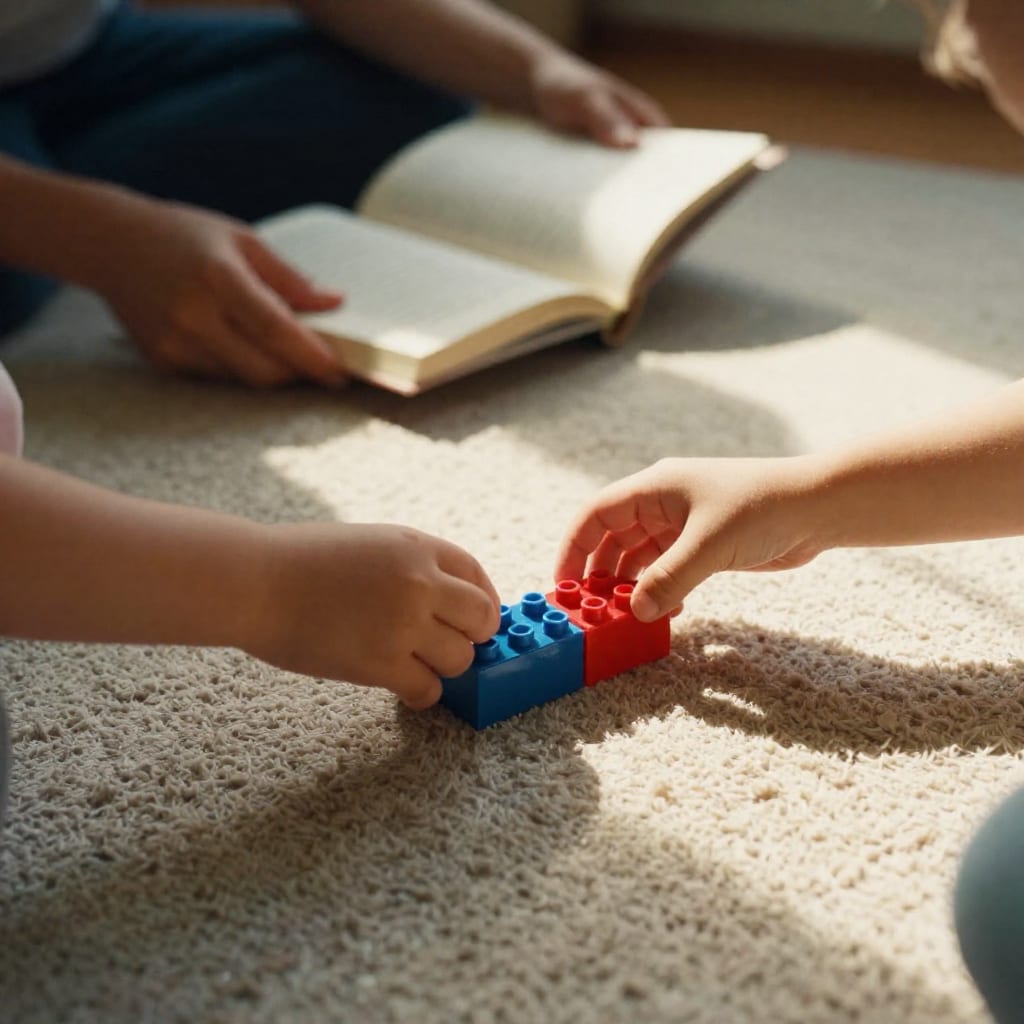
This is one of the most underrated best ways to encourage reading in reluctant readers because it removes the performance requirement entirely. When you read aloud to reluctant readers, you model fluency, expression, and the sheer pleasure of a story. You’re the warm-up act, not the examiner. Shared reading benefits go beyond literacy: it’s a bonding ritual that associates books with comfort, not criticism. The American Academy of Pediatrics emphasizes reading aloud as a key pediatric health practice precisely because of this dual cognitive-emotional impact. I started reading a chapter of “The Wild Robot” each night while my son built Legos on the floor. He never had to look at the page. A month later, he asked to borrow the book to finish it himself because he “couldn’t wait.” That’s the whole point.
Let Them Choose – Autonomy Is the Secret Sauce
There’s a specific kind of pain in watching your child pick up the same Captain Underpants book for the fifth time when you’ve just brought home a gorgeous new novel. I’ve felt it. But I’ve also watched what happens when I bite my tongue: my son reads it, laughs at the same jokes, and then — days later — reaches for something new. Autonomy is the motor. Child choice in reading is one of the strongest predictors of reading motivation in educational psychology research, and it makes intuitive sense. No adult wants to be assigned a hobby.
The trick is to create a “menu” of options you’ve pre-approved, then genuinely hand over the decision. At our house, we do a library run where I pull 10 books across different formats and difficulty levels, and he picks three. Sometimes he chooses a picture book he “should” have outgrown. I let him. Repetition and “easy” books build fluency and confidence; they’re not a regression, they’re a rehearsal. Autonomy in reading motivation works because it signals trust. When a child feels ownership over their reading life, they stop performing and start exploring.
Create a Low-Stakes Reading Environment – No Quizzes, No Logs
I killed the reading log in our house two years ago, and it was one of the best decisions I’ve made. The log, a well-intentioned school requirement, had become a nightly negotiation: “How many minutes? Did you write the title? It has to be a proper book.” My son was reading exactly 20 minutes and then slamming the book shut like he’d clocked out of a shift. The minutes were the goal, not the story.
Reading without pressure is essential for building intrinsic motivation reading habits. When the reward is a sticker or a completed log, the book becomes the obstacle to the prize. Educational psychology research on self-determination theory consistently shows that external rewards can undermine the very behavior you’re trying to promote. Instead, I focused on making reading a natural, low-stakes part of the evening — like breathing. Books sit on the coffee table, not a designated “reading nook” that feels like a time-out corner. We don’t count pages. We don’t test comprehension. Sometimes he reads for five minutes, sometimes thirty. The absence of accountability, paradoxically, has made him read more. He’s no longer performing for a log; he’s just a kid who picks up a book when he’s bored.
Connect Books to Their Passions (Even Minecraft)
I used to think Minecraft was the enemy of reading. My son could spend hours narrating his builds, but a book about anything else would gather dust. Then I found a stack of Minecraft guidebooks at a used bookstore and bought them on a whim. He devoured them. They weren’t literary, but they were dense with technical vocabulary, diagrams, and procedural text. He was reading to learn something he cared about, and that’s a different kind of stamina.
Books based on interests are the most direct bridge between a child’s existing identity and the act of reading. If your kid is obsessed with soccer, find a biography of a player, a how-to guide on drills, or a fiction series set on a team. If they love reptiles, hand them a field guide. Minecraft books for kids are a perfect example because they leverage a deep, pre-existing passion. The reading isn’t the goal; it’s the tool. Once my son realized books could serve his own obsessions, he started seeing them as useful, not punitive. That mental reframe is everything.
Model Reading Yourself – But Do It Authentically
I used to stage my reading. When my son came into the room, I’d grab a novel and strike a thoughtful pose, hoping he’d notice. He didn’t. What he did notice was when I was genuinely laughing at a memoir or squinting at a recipe. Kids have an acute radar for performance, and “model reading at home” only works if it’s real. I stopped trying to be a reading role model and just became a person who reads because she likes it.
Now, I leave my book on the arm of the couch. I talk about a confusing plot point at dinner. I’ll say, “I can’t wait to read my book before bed — it’s getting so weird.” That’s it. No lecture. Parent reading habits that are authentic and visible normalize reading as leisure, not self-improvement. My son has started doing the same thing: leaving his comic face-down on the floor, mid-story, because he’s coming back to it. That’s the cultural shift. It’s not about being a perfect reading model; it’s about being a human who reads, unapologetically.
Use Short Bursts and Series – Build Momentum Gradually
When my son finished his first chapter book independently — a 60-page Dragon Masters installment — I felt a surge of hope. But the real win wasn’t that single book; it was that there were 25 more in the series. He didn’t have to face the “what next?” paralysis. The next book was already there, waiting, with the same characters and the same comfortable rhythm. Series are the secret weapon for reluctant readers because they eliminate the cognitive load of a new world every time.
Book series for reluctant readers function like a favorite TV show. The child already knows the rules of the universe, so they can focus entirely on the plot. Short books for kids — under 100 pages, with generous spacing and illustrations — provide quick wins that build a track record of completion. I started deliberately seeking out these “snackable” books: the Mercy Watson series, the Press Start! books, the Narwhal and Jelly graphic novels. Each finished book was a brick of confidence. Short bursts of reading, done consistently and without pressure, accumulate into stamina. My son now reads longer books not because I pushed him, but because he ran out of short ones he hadn’t read twice.
Frequently Asked Questions
What if my child only wants to read graphic novels – is that okay?
Yes, and I’d argue it’s more than okay — it’s strategic. Graphic novels build vocabulary, comprehension, and narrative skills through a sophisticated interplay of text and image. Many kids who start with comics naturally branch into longer-form reading once their confidence is solid. The key is to keep offering a variety without removing the graphic novels. They’re not a problem to be solved; they’re the foundation.
How long should I push before giving up?
I’d reframe the question. “Pushing” is rarely the right verb. Instead, offer choices consistently and read alongside your child with zero pressure. This might take weeks or months, not days. The goal is to create a low-friction environment where reading is a relaxed option, not a demand. If you’re feeling frustrated, step back and let them see you enjoying a book. Consistency without coercion works.
Should I use a reward system like stickers or prizes for reading?
I don’t recommend it, and the research on intrinsic motivation backs this up. External rewards can make reading feel like a transaction, where the book is the obstacle to the sticker. Instead, focus on making reading enjoyable in its own right — through choice, humor, and connection. The reward is the story itself, and that’s the habit you want to build.
My child hates reading but loves audiobooks – does that count?
Absolutely. Audiobooks build listening comprehension, vocabulary, and an understanding of story structure — all of which are foundational to reading success. For many struggling readers, audiobooks remove the decoding barrier and let them access the joy of narrative. I’ve seen this firsthand: a child who loves audiobooks is a child who loves stories, and that’s the core identity you want to nurture.
What if they choose a book that's too easy or they've read before?
Let them. Repetition builds fluency, confidence, and a sense of mastery. Choosing an “easy” book is often a sign that a child is seeking comfort or a win — and that’s a healthy reading behavior. My son has read the same Dog Man book four times, and each time he notices new jokes. That’s not stalling; that’s deepening comprehension. Trust the process.
Worth bookmarking: The next time you’re at the library, pull 10 books you wouldn’t normally choose and let your kid surprise you with what sticks. Sometimes the best way to encourage a reluctant reader is to get your own expectations out of the way.